
Hong Kong Baptist University and Partner Institutions Reveal Cardiovascular Protective Mechanism of Sclerostin Protein
December 15, 2025
Osteoporosis, a highly prevalent chronic bone disease, significantly increases patient morbidity and mortality through fracture-related complications. With accelerating population aging, patient numbers are growing exponentially, creating urgent demand for effective treatments. Sclerostin (SOST), a negative regulator of bone formation, has emerged as an important therapeutic target for bone metabolic diseases. In 2019, Romosozumab, a monoclonal antibody primarily targeting the loop2 domain of sclerostin, received US-FDA approval for treating postmenopausal osteoporosis with high fracture risk—a milestone in the history of osteoanabolic therapeutics. However, cardiovascular events including myocardial infarction and stroke were reported during clinical trials and post-marketing surveillance, prompting the US-FDA to issue a "black box warning" regarding cardiovascular risk. The European Medicines Agency (EMA) restricted its use to severe postmenopausal osteoporosis patients without history of heart attack or stroke. This means postmenopausal osteoporosis patients with cardiovascular disease history cannot receive Romosozumab for osteoanabolic therapy, creating an unmet clinical need for cardiovascular-safe sclerostin inhibitors for this patient population.
Meta-analyses of cardiovascular event data from Phase III clinical trials of anti-sclerostin antibodies, combined with meta-analyses of populations carrying SOST gene mutations associated with high bone mineral density, indicate that reduced sclerostin levels—whether from therapeutic intervention or congenital genetic mutations—are associated with increased cardiovascular event rates. Previous research by the Hong Kong Baptist University team demonstrated that sclerostin participates in inhibiting bone formation and suppressing cardiovascular events such as atherosclerosis through different structural domains. The loop2 and loop3 domains of sclerostin are involved in its inhibitory effect on bone formation, while sclerostin's suppression of cardiovascular events is independent of the loop3 domain. However, the mechanism by which sclerostin functions in the cardiovascular system remained unknown.
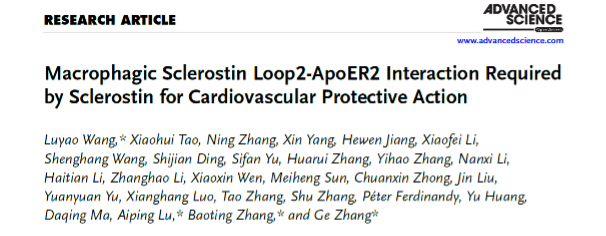
Recently, Professor Zhang Ge's team from the Law Sau Fai Institute for Advancing Translational Medicine in Bone and Joint Diseases at Hong Kong Baptist University (scRNA-Seq-based disease molecular mechanism research), Professor Wang Luyao's team from the Greater Bay Area International Research Platform for Aptamer-based Translational Medicine and Drug Discovery (target molecular mechanism research), Professor Lyu Aiping's team (Member of Academia Europaea) from the Institute of Systems Medicine and Health Sciences at Hong Kong Baptist University (computational biology research), Professor Zhang Baoting's team from the Faculty of Medicine at The Chinese University of Hong Kong (cardiovascular experimental model establishment and evaluation), Professor Ma Daqing (Member of Academia Europaea) from Imperial College London Faculty of Medicine (genome-wide association analysis of SOST gene variants encoding sclerostin in UK Biobank), and Professor Huang Yu (Member of Academia Europaea) from City University of Hong Kong (cardiovascular experimental design strategy) collaboratively published a research article titled "Macrophagic Sclerostin Loop2-ApoER2 Interaction Required by Sclerostin for Cardiovascular Protective Action" in the international journal Advanced Science.
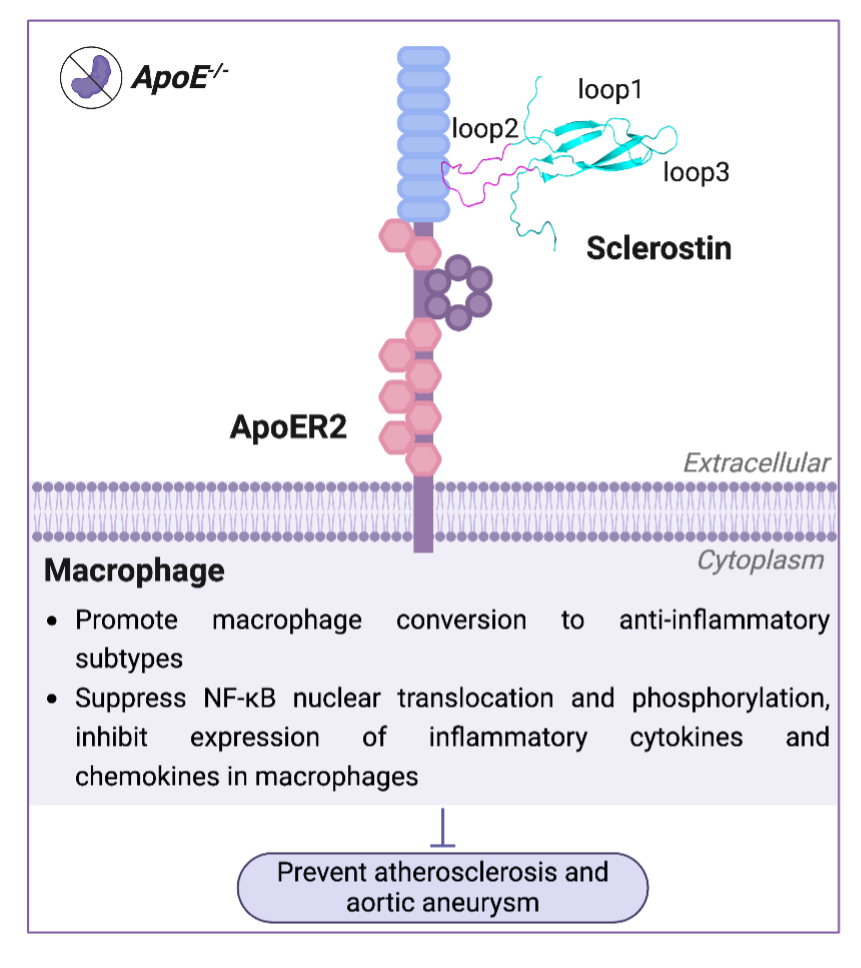
This study elucidates for the first time the molecular mechanism by which sclerostin protein protects the cardiovascular system. The research demonstrates that the interaction between the loop2 domain of sclerostin and apolipoprotein E receptor 2 (ApoER2, also known as LRP8) on macrophages contributes to sclerostin's inhibitory effect on atherosclerosis-related cardiovascular events. This work establishes the theoretical foundation for developing next-generation osteoporosis therapeutics without cardiovascular risk.
Notably, this study identifies macrophage ApoER2 as a novel receptor for sclerostin for the first time and elucidates in ApoE⁻/⁻ mice (a classical animal model for atherosclerosis-related cardiovascular disease) that the interaction between sclerostin loop2 domain and ApoER2 mediates sclerostin's inhibitory effects on NF-κB-driven inflammatory responses, atherosclerosis, and aortic aneurysm. This discovery suggests that sclerostin protein plays a compensatory protective role in the cardiovascular system when ApoE is deficient or mutated. From a translational medicine perspective, this study provides preclinical evidence for predicting cardiovascular risk populations (such as those with APOE gene variants) using the marketed anti-sclerostin loop2 domain antibody (Romosozumab). Furthermore, specific targeting and inhibition of the sclerostin loop3 domain while preserving the interaction between sclerostin loop2 domain and macrophage ApoER2 may represent a next-generation cardiovascular-safe precision strategy for sclerostin inhibition.
Professor Zhang Ge from the Law Sau Fai Institute for Advancing Translational Medicine in Bone and Joint Diseases at Hong Kong Baptist University, Professor Wang Luyao from the Greater Bay Area International Research Platform for Aptamer-based Translational Medicine and Drug Discovery, Professor Zhang Baoting from the Faculty of Medicine at The Chinese University of Hong Kong, and Professor Lyu Aiping (Member of Academia Europaea) from the Institute of Systems Medicine and Health Sciences at Hong Kong Baptist University are the co-corresponding authors of this paper. Professor Wang Luyao from the Greater Bay Area International Research Platform for Aptamer-based Translational Medicine and Drug Discovery, Ms. Tao Xiaohui (PhD candidate) from the Law Sau Fai Institute for Advancing Translational Medicine in Bone and Joint Diseases at Hong Kong Baptist University, Dr. Zhang Ning (Postdoctoral Fellow) from the Faculty of Medicine at The Chinese University of Hong Kong, Mr. Yang Xin (PhD candidate) from the Institute of Systems Medicine and Health Sciences at Hong Kong Baptist University, and Dr. Jiang Hewen (Postdoctoral Fellow) from the Faculty of Medicine at The Chinese University of Hong Kong are the co-first authors of this paper. Professor Ma Daqing (Member of Academia Europaea) from Imperial College London provided critical guidance on UK Biobank sample analysis in this study. Professor Huang Yu (Member of Academia Europaea) from City University of Hong Kong provided critical guidance on cardiovascular experimental design for this study.
Original article: https://doi.org/10.1002/advs.202518735


